Celtic Gold In The Mud: What A Stater Really Is (And Why It Makes Detectorists Go Weak At The Knees)
 admin
Posted On November 21, 2025
admin
Posted On November 21, 2025

Celtic Gold In The Mud: What A Stater Really Is (And Why It Makes Detectorists Go Weak At The Knees)
There are good signals, there are heart-stopper signals, and then there is the moment your machine screams on a tight, shallow target and a thumb-sized disc of ancient gold winks up at you from the plug.
Everyone online calls it “a Celtic stater”. People congratulate you in capital letters. A bloke you have never met tells you in the comments that he “would have walked over that”. Someone mentions the British Museum. You pretend to be calm, but your hands are shaking like you have just necked three espressos on an empty stomach.
So what actually is a Celtic stater in the UK? And why is it such a big deal?
What a Celtic stater really is
In plain English: a Celtic stater is a high-value Iron Age coin, usually gold, sometimes silver or bronze, used by the tribal societies in Britain in the couple of centuries before the Romans turned up and ruined everyone’s fun.
It is not Roman.
It is not medieval.
It is not “sort of Saxon”!
It is pre-Roman tribal money. Late Iron Age. Proper old.
The word “stater” itself is a modern label, borrowed from the Greek world, where it referred to a standard weight of gold or silver. The Celts never called them “staters” in a coin catalogue sense, but the name stuck because these coins broadly follow weight standards and behave like a main unit of currency.
In UK terms, when we say “Celtic gold stater” we are usually talking about a chunky gold coin, often around the 5–7 gram mark, struck by a local tribe or ruler in Britain, or imported from continental Gaul and then copied, dating broadly from around 150/100 BC through to the decades either side of the Roman invasion in AD 43.
In other words, you are holding the big money of late Iron Age Britain.
How they got here: from Greek glamour to British hedgerow
The story of the stater is basically a game of artistic Chinese whispers.
It starts with Philip II of Macedon. His gold staters carried a lovely classical design: serene head of Apollo on one side, a chariot scene on the other. These coins travelled, impressed people, and got copied by tribes in Gaul, who tweaked the designs into more “Celtic” versions.
Then, across the Channel, British tribes looked at those Gallo-Belgic coins and thought “we’ll have some of that”. Gold flowed into southern and eastern Britain through trade, migration, mercenary pay, and whatever the Iron Age equivalent of dodgy import channels was.
At first, the imports are basically continental coins. Over time, British tribes begin minting their own versions, sometimes literally melting down the earlier staters and restriking them with local designs and, later, with the names of British rulers.
So that stater in a modern UK field is the end result of Greek royal propaganda becoming Gallic tribal money, becoming British tribal power-symbol, becoming your best day out this decade.
Where in Britain they belong
Celtic staters are not evenly spread across the UK like confetti. They cluster where coin-using tribes were active and wealthy.
Southern and eastern England is the main playground. Names you will see in the books include the Catuvellauni and Trinovantes north of the Thames, the Atrebates and Regni in the south, the Dobunni around the Severn, the Iceni in East Anglia, the Corieltauvi further north and inland, and the Durotriges and others on the western and southern fringes.
Each of these tribal groups has its own coinage story. Some pumped out more gold, some focused on silver and bronze, some barely bothered at all. The result is that certain parts of modern Britain are far more likely to produce staters than others.
If your permissions sit in one of these tribal heartlands, particularly in southern and eastern counties, your chances go up. If you are freezing on a windswept hill in somewhere that did not really use coinage before the Romans, you may be digging more “mysterious lumps of nothing” than staters.
What they were worth
This is the bit people often skip: what did a stater actually buy?
Exact values are messy because we are dealing with a non-standardised economy, but we can be confident of one thing: this was not small change. Gold staters were big-value units. You are in the realm of warbands and warriors being paid, tribute and diplomacy between elites, religious offerings, and large livestock or high-ticket goods.
If you think of a stater as the Iron Age equivalent of a high-end banknote or bar of tradable gold, you are in the right psychological space. It is not the coin someone drops on the way out of the tavern. It is the coin that moves when serious things are happening: alliances, bribes, ritual deposits, paying the lads before a fight. Which is why they so often turn up in hoards.
How they end up in your field
Celtic staters do not stroll into your permission by accident. They have stories attached, even if we will never know the exact script. There are a few main ways they likely ended up in the ground.
Hoarding in uncertain times. People bury wealth when scared. Raids, looming conflict, succession crises, the early shadow of Rome on the horizon – all good reasons for someone to walk out at dusk, dig a hole, and stash a handful of gold in a pot or leather bag. Then, for whatever reason, they never come back.
Ritual offerings. We are dealing with people for whom the line between religion, politics and daily life was extremely thin. Rivers, springs, boundaries and special sites attracted offerings. Staters may have been thrown into water, buried near shrines, or placed as part of ceremonies we can only guess at now.
Payment and loss. Move enough high-value coins through a landscape and some will be lost in transit, dropped from belts, bags or mounts. Not common, but possible. The same way modern notes occasionally blow across a car park, except with more kings, spears and wool cloaks involved.
Inheritance and forgetfulness. Land changes hands. Memory fails. The family that knew there was a stash “out past the big oak, where the land dips” dies out, moves on or is scattered. The ground keeps the secret until some idiot with a beeping stick and a flask of tea turns up two thousand years later.
What they look like (and why they look so strange)
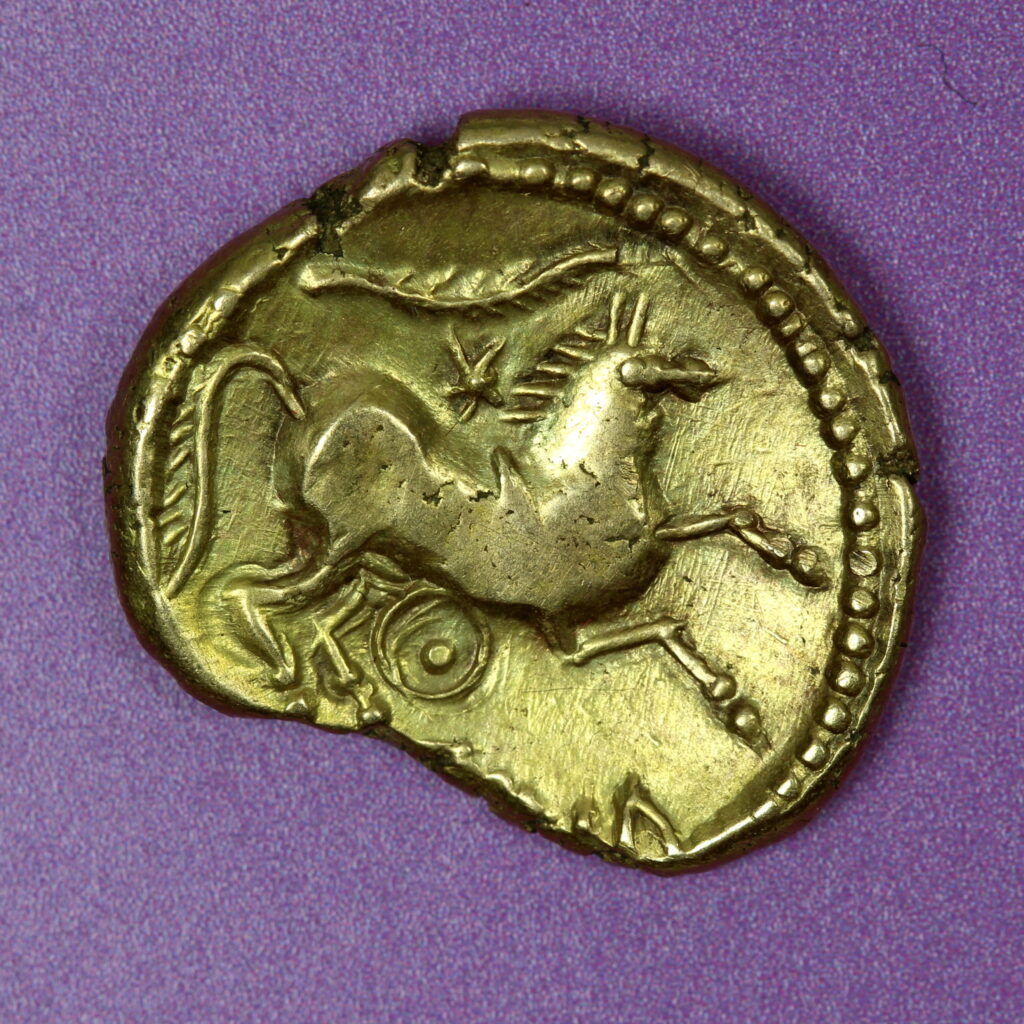
If you have never handled one, you might reasonably expect something neat and classical. Spoiler: a lot of staters look like someone tried to draw a horse and a chariot from memory while riding in the back of a cart on a bumpy track.
Early issues are closer to their Greek ancestors. Later British staters often feature a wildly stylised horse, sometimes looking more like a centipede with attitude; wheels, pellets, whorls and abstract patterns; crescent shapes, sun symbols, strange plant or shield-like elements. On later issues, you start seeing the names of rulers in a Romanised script: Cunobelin, Tasci, Verica and so on.
To a modern eye, it is both alien and weirdly modern. You can see why designers and artists love them. They are like Iron Age logo work: distilling ideas of kingship, prestige, sun, horse, power and motion into tiny bursts of abstraction.
Why detectorists obsess over them
There are plenty of reasons a Celtic stater sits very close to the top of a UK detectorist’s wish list.
It is rare enough to feel like a lifetime find, but common enough that it is not just myth. It is visually striking – even the scrappier ones have presence. It plugs straight into a period that feels genuinely ancient, pre-Roman, almost mythological. It screams wealth, power and story in a way few other coins do.
You are not just holding money. You are holding the echo of a tribal king’s authority; the residue of a deal, a sacrifice, a nervous burial before war; the final physical trace of someone whose name is long gone, but whose decision to bury or drop that coin you have just undone.
From a storytelling point of view, it is dynamite. Roman grot near the gate is fine. Celtic gold stater from a hoard in the high corner of the field, overlooking the ancient ridgeway is the sort of line that makes people stop scrolling.
The modern responsibility bit
You cannot talk about staters in the UK and pretend it is still the Wild West.
In modern Britain, a Celtic gold stater ticks all the boxes that make the heritage world sit up. It is pre-Roman, often gold, and frequently part of something larger, and that means it is almost certainly Treasure under UK law if found as part of a hoard or with other precious-metal items. It needs to be reported properly, through the Portable Antiquities Scheme or direct to the coroner where required. It deserves a proper record: grid reference, soil context, associated finds, not just “found in field lol”.
The good news is that the system, while not perfect, exists to get these things recorded, studied and, ideally, seen. And that means your find does not just become another forum brag. It becomes part of the story of Britain.
And if you are lucky enough to dig one, you will know exactly why people go quiet for a moment when they see it in the palm of your hand.

Trending Now
The Day Everything Changed: Detectorists’ Genuine Life-Changing Finds

The Farmers guide to understanding the modern detectorist...
You may also like