
There are two types of detectorist in Britain.
Type one finds a musket ball, sighs loudly, and tosses it into the “lead again” pocket like it has personally offended them. Type two finds a musket ball and quietly feels something shift inside them. A small moment of connection. A reminder that this field was once a place where people stood, trained, fought, panicked, bled, and went home changed.
This article is for type two. And for type one, because you can be redeemed.
Welcome to the Great Musket Ball Appreciation Society, an entirely unofficial movement dedicated to the idea that lead is not boring. It is evidence. It is lived history. And it is one of the most under-rated categories of find in UK detecting, mostly because it is not shiny and cannot be photographed in flattering light for the internet.
First, let’s kill the myth: musket balls are not all the same. Yes, they are often round-ish lumps of lead. But so are most people’s hobbies, if you look close enough. The interesting part is what they tell you, and what you can start to read once you stop treating them as scrap and start treating them as clues.
If you are finding musket balls, you are standing in a landscape that still remembers the noise.
The obvious story is battle. Britain loves a battle. Our soil is basically a national archive of poor decisions made at speed. But most musket ball scatters are not dramatic last stands. They are practice, training, militia drilling, hunting, or the everyday reality of armed life across several centuries. Not every lead ball is from a famous battle. Many are from quieter, more human moments: men learning to load and fire, missing targets, dropping ammunition, casting shot, and trying again.
That matters because it changes how you detect. A battle site is often a distinct pattern. A training area can be a repeated pattern. A hunting ground can be a boundary pattern. Once you start noticing where the lead sits in a field, you stop thinking “another musket ball” and start thinking “why here?”
Now, let’s talk about the object itself.
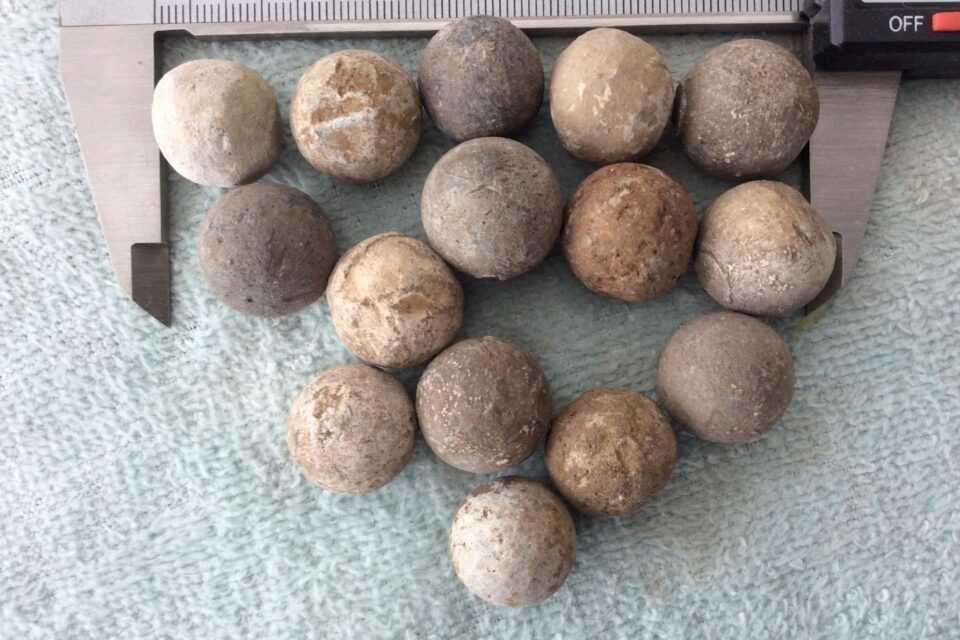
A musket ball can carry scars. Flattening can suggest impact. A sprue mark can hint at casting. A gnawed ball can be animal-chewed lead, which is both fascinating and slightly grim, because animals have been finding human rubbish for centuries too. A ball with bite marks, cuts, or deformation can tell you it was dropped, fired, struck something hard, or reworked. Even the size can indicate different weapons or periods, though you have to be careful. Lead doesn’t come with a label, and guessing wildly is how you end up declaring “Civil War battlefield” because you found three balls near a footpath and a can of Stella.
The deeper point is this: musket balls are often the first sign that your permission has a story beyond coins.
Coins can tell you who passed through. Lead can tell you what happened there.
And here is the bit nobody wants to say out loud: musket balls are often more common than coins because shooting was common. Training was common. Carrying weapons was common. Losing ammunition was common. And for long stretches of British history, the countryside was not just farms and footpaths. It was readiness. It was militia organisation. It was contested land. It was a place where local men were expected to know how to shoot, whether they wanted to or not.
So when you find musket balls repeatedly, you are not finding junk. You are finding repetition, behaviour, and pattern. You are finding evidence of routines that disappeared from the surface but never left the soil.
Now, a brief but important public service announcement. Lead is lead. Handle it sensibly. Do not chew it. Do not let kids treat it as treasure sweets. Wash hands before you eat. Bag it. Take it home. If you are regularly finding a lot of lead, consider separating it properly and disposing of it responsibly. Being historically passionate does not mean being chemically casual.
Back to the romance.
There is a particular mood that comes with a musket ball. It is not the triumph of a hammered coin or the adrenaline of a gold ring. It is quieter. More reflective. You hold it and realise it is a simple thing that travelled through a violent mechanism. It existed in a world where conflict was closer, louder, and less optional. Someone carried it. Someone loaded it. Someone might have fired it in anger, or in training, or in fear. Then it was gone. Into the ground. Into silence.
And now it is in your hand.
That is not boring. That is the whole point of detecting.
So here is the Society’s pledge, if you want one. The next time you find a musket ball, do not dismiss it. Look at it. Photograph it. Log it. Note where it came from. Collect the pattern. Treat it as a piece of a larger story, not a minor inconvenience between coins.
Because the day you stop rolling your eyes at lead is the day your permission gets deeper.
And if you still cannot love musket balls, fine. Put them in your scrap pocket. But do not be surprised when the person next to you, quietly bagging theirs with a small grin, turns out to understand the field better than you do.